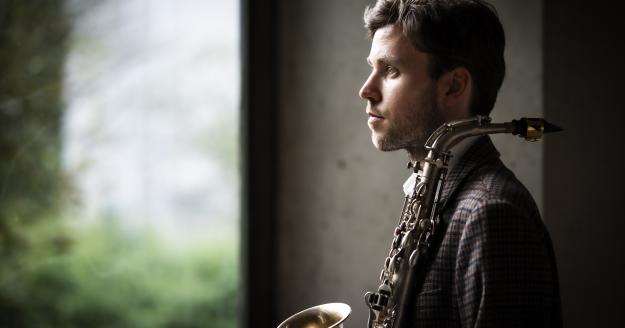
Kurt Bertels: A disclosure and contextualization of the Brussels Saxophone School between 1867 and 1904: towards a historically informed performance practice
The concept of Historically Informed Performance Practice (HIPP) plays a prominent role in contemporary music scene. While initially focused on Early Music, this approach is now increasingly applied to music from the nineteenth and early twentieth centuries. Central to HIPP is the pursuit of historically aware performances, a practice that remains relatively uncommon in the field of saxophone music. This doctoral research aims to explore this underexplored area by focusing on the historically informed performance practice of the world’s first saxophone school, the Brussels Saxophone Class (1867-1904).
Nuno Cernadas: Alexander Scriabin’s Ten Piano Sonatas: an Interpretative Journey through his Musical Cosmos
Alexander Scriabin (1872–1915) was an innovative composer who, through a significant evolution in his musical language, found a way to free himself from the constraints of tonal music and transitioned to an uninhibited form of musical creation. Two connected elements that accelerated this transformation were his developing mysticism and his perception of color as the visual counterpart of sound, brought about by either synesthesia or conscious artistic intent. In this PhD research by Nuno Cernadas, Scriabin’s color and sound symbiosis and his relationship to mystical philosophy, as in Prometheus: The Poem of Fire (Op. 60), will be studied in order to apply these ideas to the creation of an original multisensory live concept for the performance of his ten piano sonatas. The research will focus on the mystical philosophies that influenced Scriabin, their historical and cultural significance in early twentieth-century Europe, and their role in the development of Scriabin’s style. The researcher will undertake an in-depth study of Prometheus, his first attempt to produce a multisensory work of art blending color and music in a transfigurative masterpiece. Musical interpretation and performance practice are equally central. Through the synaesthetic exploration of Scriabin’s ten piano sonatas, this project will create a musical and visual experience that follows and continues the visionary intentions of the composer.
Sarah Defrise: Joseph Jongen`s forgotten songs, an interpretation diary
Joseph Jongen was born in 1873 and died in 1953 at age 70. He is generally considered as one of the most prominent Belgian composers after César Franck. Particularly known for his organ and chamber music works, he also composed more than fifty art songs. The complete set of songs encompasses a wide scope of styles, from strophic romances to impressionist or Straussian-like songs, setting to music texts by various poets and writers - some famous ones such as Baudelaire, Hellens or Verhaeren, or others with whom he was acquainted. Not only more than one third of the songs has never been published nor recorded, in addition the remaining two thirds are very seldom heard. I therefore decided to dedicate a doctoral research on the analysis and interpretation of these songs. On the one hand, it will bring back to life an unjustly forgotten part of Jongen’s work and encourage young singers to perform his music, and on the other hand it will help me to refine my methodology as an interpreter in approaching a new repertoire.
Koen Dries: Voyages. Dualism in artistic research and performance of a saxophone player. An interdisciplinary approach.
While continuously making an effort to improve performance quality, performing musicians don’t cease to challenge their own physical and artistic possibilities. Two different approaches are widely spread: the “artistic approach”, often accused to lack uniformity and objectivity, and to be trial and error based, is an individual oriented method focusing on the whole playing apparatus with conclusions formulated in a personal terminology. The “scientific approach”, often accused to have little applicability in a practical context, focuses on small segments of the playing apparatus studied under controlled laboratory conditions. During preliminary research, we tried in cooperation between scientists and artists to develop an observation method unifying these two essentially complementary approaches. Although looking very promising, due to technical limitations these observations rendered no really usable results so far. By focusing on different aspects of the playing apparatus in a four-stage research process, this project aims to fill the gap and to develop a new approach, which should be capable of making recent discoveries from positive sciences usable for artistic performance, not only on saxophone, but by extension other wind instruments too.