INARJ-conference for the first time in Brussels: jubilee edition on ‘place’ and ‘space’
From the 25th to the 27th of February 2026, the Koninklijk Conservatorium Brussel (KCB) had the honour of welcoming the fifth edition of the International Network for Artistic Research in Jazz (INARJ) within its walls.
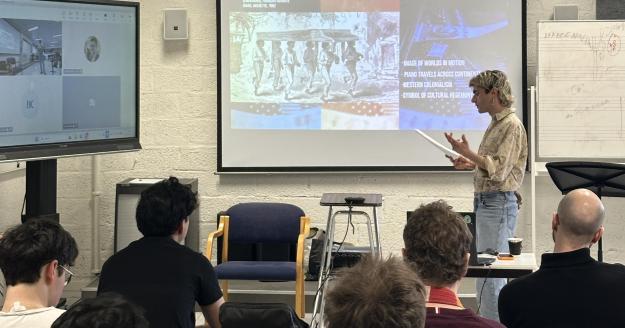
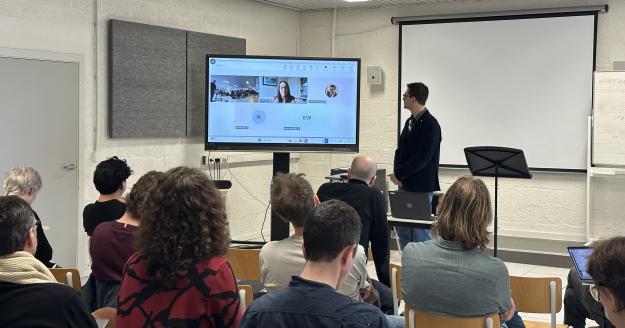
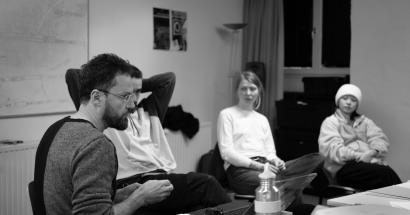
Around twenty researchers, artists and musicians from around the world were present, both online and in-person, in Brussels to discuss the conference theme Places and Spaces. An invitation to reflect on the future of jazz, both in practice and in research.
For the first time in Belgium
On the 25th of February, the INARJ conference began with a formal introduction. But the jubilee edition was officially opened on the 26th of February in the jazz department at Campus Kaai. Matthias Heyman, researcher and professor at the KCB and the Vrije Universiteit Brussel (VUB), warmly and humorously welcomed the participants as host for these three days. It is largely thanks to him that this year’s INARJ conference is taking place in Brussels. After several editions in Vienna, the network members decided to organise this edition in Brussels.
But what makes Brussels such an interesting choice? As surprising as it may sound, Brussels is a cluster for jazz research thanks to the Koninklijk Conservatorium Brussel. The conservatoire has 8 jazz researchers, a remarkably high concentration given the global spread of those engaged in artistic research in jazz.
An edition centred on ‘place’ en ‘space’
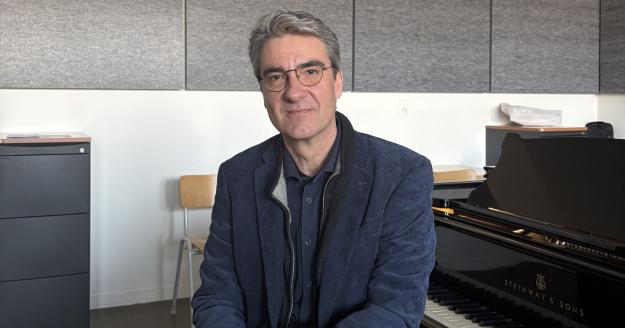
INARJ is an international network, founded in 2019, which aims to support and strengthen the rapidly growing field of artistic research in jazz. Michael Kahr, its founder, initiated a gathering of colleagues from related disciplines in Vienna at the JAM Music Lab Private University for Jazz and Popular Music, where he teaches.
Each conference highlights different themes and aspects of jazz research. This year, INARJ put the focus on two key concepts in artistic research: place and space. As explained by Monika Herzig, professor and researcher at the JAM Music Lab Private University for Jazz and Popular Music, we live in a global society and place. Where we are and what we do coin our music in two ways. On the one hand, there are spaces where it is unique, and on the other hand spaces where it all comes together in a global mix. This raises several questions: what is our artistic practice, and how does that fall in today’s context? Are we going to stay in our space and stay unique? Or are we going to make a space with others in the community? An important and timely concept for jazz practice.
Michael Kahr, founder of the INARJ network
We’ve become such a global society and place. Where you are and what you do really coin your music in two ways. We have the spaces where it’s unique, and then we have the spaces where it all becomes together in a global mix.
This concept of artistic research raises questions: what is your artistic practice? How does that fit into today’s context? Are you going to stay in your space and stay unique? Or are you going to make a space with others in the community?
Monika Herzig
The future of jazz
Even though its social and academic impact has yet to be determined, jazz research can be valuable for young people and students, for teenagers and people who began to learn jazz at a young age. Jazz research can help them unlock their potential in improvisation and find their own voice and role in society. Professors in higher music education can contribute to the structure of lessons and the development of the entire curriculum for jazz students, enabling them to pass on their knowledge to the next generation.
Jazz practice will indeed continue to evolve, both in digital spaces and ecological spaces, two themes that were highlighted during this INARJ conference.
As explained by Michael Kahr, digital spaces are very important, not only in terms of self-representation on social media but also because music itself is changing via formats like TikTok. Music examples are shorter, which is unusual for jazz. Some people are adapting to this new format, and it changes the way jazz is perceived by musicians and the public. Artificial Intelligence (AI) will also continue to have a significant impact, of course. The sixth edition of the INARJ conference will delve deeper in this thematic of artistic research and technology.
Ecological spaces are also of great importance. Jazz musicians are particularly environmentally conscious. They often travel around the world and strive to reduce their ecological footprint. This is reflected in the concept of artistic citizenship, which is embedded in jazz education. Jazz musicians do not consider themselves merely as pure artists waiting to be discovered and placed on the concert stage. They also possess a strong social awareness, which includes environmental matters.
Transformation of the network
During this fifth edition of the INARJ conference, the transformation of the INARJ network was also officially announced.
The INARJ network will soon become a Special Interest Group of the Society for Artistic Research (SAR). This will include a formal call for membership.
For more information, click here