María González Calvo
Onderzoek

Researcher in the Spotlight: María González Calvo

Rediscovering the Art of Basso Continuo: María González Calvo on Dissonance, Freedom and Historical Sources

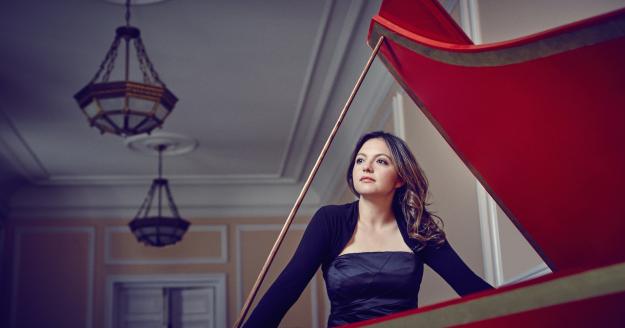
Harpsichordist María González Calvo recently completed her PhD at the Koninklijk Conservatorium Brussel. Her research explores a fascinating but often overlooked aspect of seventeenth- and eighteenth-century performance practice: the use of mordenti and acciaccature in keyboard basso continuo.

These ornaments were part of a broader approach known as suonar pieno, literally “full-voiced playing”. Rather than simply providing harmonic support, the continuo player created a rich musical texture in which dissonances contributed to what historical musicians described as a “wonderful perfection of harmony”. For Gonzalez Calvo, researching these practices is not about reconstructing a fixed historical recipe, but about rediscovering musical possibilities that performers today may have lost.

María González Calvo

From family music to the harpsichord

Music was part of Gonzalez Calvo’s life from an early age. Growing up in Salamanca, she remembers her grandfather playing the accordion and singing at family gatherings, while her parents also sang at home. “Music was something natural to me,” she recalls.

Her first encounter with the harpsichord was almost accidental. When she entered the music academy as a child, the piano department was full, so she initially chose the bassoon. However, she was too small for the instrument, and the music academy had no smaller one. A year later, she discovered the harpsichord. “It had keys, so I thought: well, it’s like a piano.” She was eight or nine years old and quickly fell in love with its sound.

After studying in Barcelona, she moved to Basel, where she spent many years studying and working as a harpsichordist and accompanist. She eventually came to Brussels to teach basso continuo, where the opportunity for doctoral research emerged.

More than accompaniment

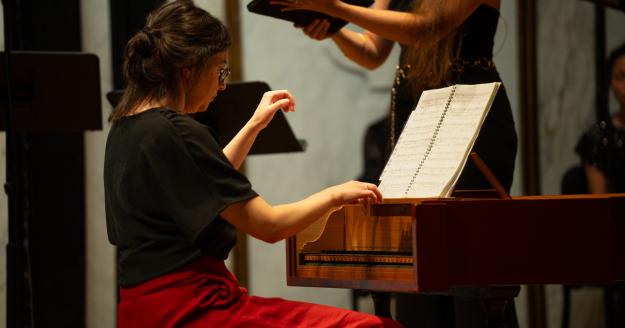
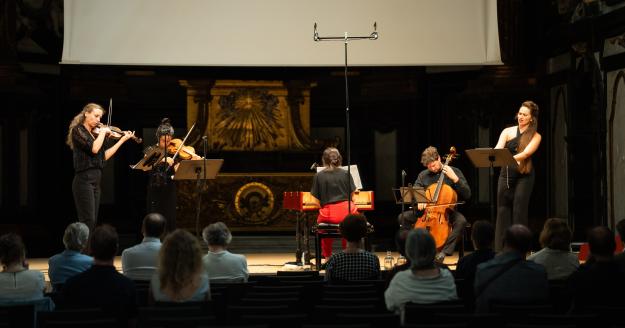
For Gonzalez Calvo, basso continuo is far more than accompaniment. The bass line provides the foundation, but the performer must decide how to realise the harmony, how many voices to use, how to shape the texture and how to interact with other musicians. “When you see how they did it at the time, it can be just as demanding as playing solo, also in virtuosic terms,” she explains.

The challenge is not only technical. The continuo player must give the other musicians freedom while creating the framework that holds the ensemble together. “You have to lead the ensemble, but at the same time everybody has to feel free. You need a frame in which everybody can fit together.”

María González Calvo

A full sound and pleasant dissonances

Her doctoral research focuses on the Italian practice of suonar pieno, or full-voiced playing. The richness of the texture is essential: only within a carefully constructed harmonic structure do mordenti and acciaccature acquire their full expressive meaning. “You first have to construct the texture. Then you can add these notes,” she explains. This is not simply a matter of adding more notes, but of creating different layers of voices, colours and contrapuntal relationships. 

Historical musicians described these ornaments as “pleasant dissonances”, even contributing to a “wonderful perfection of harmony”. What may sound surprising or harsh to modern ears can make perfect sense within the harmonic whole. This practice also reflects the changing musical language of the late seventeenth century. As opera and cantata developed, composers explored new ways of using dissonance. “Composition and accompaniment go hand in hand,” says Gonzalez Calvo. “As musical language changes, so does the way musicians accompany it.”

María González Calvo

Reading historical sources from within

One of the greatest challenges of her PhD was learning to understand historical sources in their original context. Written in early Italian, French and German, these texts often assume knowledge that is no longer part of a musician’s training today. Historical musicians learned counterpoint and improvisation from childhood, developing the ability to improvise in several voices. Such skills are much less common in contemporary instrumental education.

Gonzalez Calvo was particularly struck by how practical many historical treatises are. Some even specify exactly which notes to play and which fingers to use. “The practice came first, and then it was written down. Our task is to read it and bring it back to the keyboard.”

From Cesti to the Scarlattis

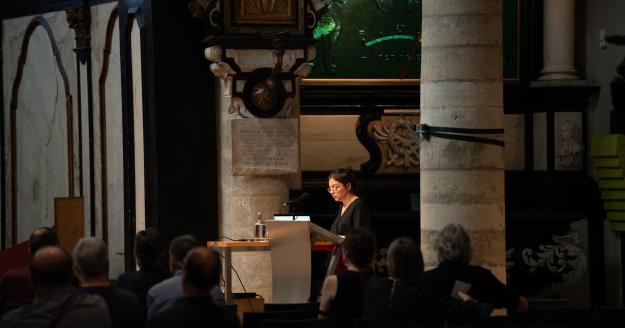
For her doctoral defence, Gonzalez Calvo brought together music by composers including Cesti, Corelli, Albinoni, Alessandro Scarlatti and Domenico Scarlatti. Her aim was to trace stylistic changes rather than present a single, fixed version of “the Italian style”. “Domenico Scarlatti does not sound the same as Alessandro Scarlatti, and Alessandro does not sound the same as Cesti. Those years in between are really important.” The continuo should therefore evolve with the musical language. Her research helps musicians recognise the differences between music from, for example, the 1660s, 1690s and 1730s, rather than treating the entire period as one uniform style.

These differences are also audible to listeners. When the continuo is shaped according to the music’s historical style instead of being reduced to a generic sequence of chords, the harpsichord becomes more present. “You don’t necessarily know what is happening, but you suddenly notice the harpsichord.”

María González Calvo

Freedom through knowledge

Gonzalez Calvo says her PhD did not fundamentally change the way she plays. It did, however, give her the time and resources to study historical sources in much greater depth. This has strengthened her musicality and technique, making her a better musician and teacher, while also leaving her with more questions. The deeper she explored the sources, the more possibilities she discovered. Not everything has a clear-cut answer, and acknowledging uncertainty is an essential part of research. “If something is particularly challenging or difficult to understand, documenting the difficulty and accounting for why it arises is also part of the research.”

For Gonzalez Calvo, historical sources do not restrict creativity or inspiration. On the contrary, they expand the performer’s possibilities. “The more you go to the sources, especially the practical ones, the more knowledge you gain and the more free you are. You are able to choose better.” Historical research thus offers musicians not a set of rules to follow blindly, but a richer vocabulary for making informed musical decisions. Artistic research also means bringing that knowledge back into the hands and ears of musicians today.

👉Curious to discover María González Calvo’s work? Visit her website to learn more about her musical activities.

👉Her new CD, due for release in 2027, will explore diminutions in the style of Silvestro Ganassi. Together with recorder player Vicente Parrilla, soprano Lina López and harpist Vera Schnider, she explores how Ganassi’s refined art of ornamentation can come to life on different instruments, in a fascinating musical dialogue.

Deel dit