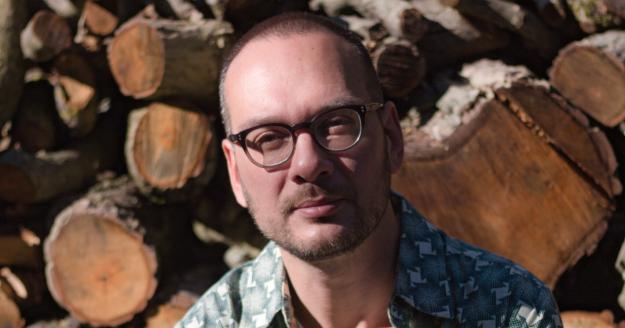
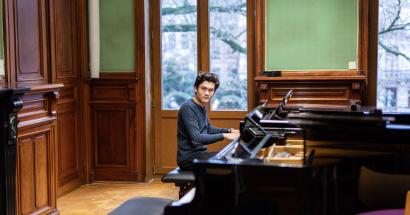
Piergiorgio Pirro © Rolanas Stankūnas
Onderzoek

Researcher in the Spotlight: Piergiorgio Pirro

Rethinking jazz: Piergiorgio Pirro on sound, improvisation and exploration

© Rolanas Stankūnas

Brussels-based pianist, composer and researcher Piergiorgio Pirro moves fluently between jazz performance and artistic research. He completed his doctorate at KCB on the 29th of January. His work explores an unusual intersection: the meeting point between spectral music and jazz improvisation. What happens when a highly structured, sound-based compositional approach enters the fluid, co-creative world of jazz? His answer is both practical and philosophical.

Building a musical and research identity

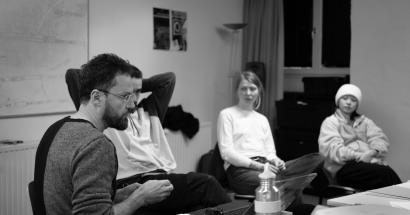
Piergiorgio © Morgane Griffoul

© Morgane Griffoul

Piergiorgio Pirro’s musical path began in the family. “Music was always around. My father plays guitar and piano, so there were instruments at home. From the beginning, I was drawn both to classical music and to jazz and popular music.”

His move to Brussels in 2014 marked a turning point. Coming from Italy, where formal jazz education was not always considered essential, he encountered a different ecosystem. “Here, almost everyone had a formal training in jazz. That’s when I decided to enter the conservatory.”

Alongside his musical training, he also studied computer science. While he chose music as his main path, this background still shapes his work. “It gives me tools and a mindset: how to reason, how to structure questions, and work with sound through technology.”

A new sound, a new question

“I’ve always been interested in understanding how music works from the inside,” Pirro explains. “Jazz musicians naturally want to know: how is this sound made? Can I do it too?”

The starting point for his doctoral research was a moment of listening. Encountering the music of saxophonist Steve Lehman, Piergiorgio Pirro found himself - along with many of his peers - fascinated but puzzled. “Everyone was blown away by this sound, but no one could really explain it or reproduce it,” he recalls. “I later discovered that Lehman was drawing on spectral music. That became my entry point.”

Spectral music, developed by composers such as Gérard Grisey and Tristan Murail, focuses on the internal structure of sound, and on its continuity in frequency and time. Bringing these ideas into jazz raises immediate tensions. “Spectral music often involves control and structure. Jazz relies on spontaneity and interaction. The question was: can these approaches coexist?”

Reframing jazz practice

LinnStrument

Piergiorgio Pirro did not simply apply spectral techniques to jazz composition. Instead, he used the small ensemble as a laboratory, maintaining a high degree of improvisation. “I wanted to keep what defines jazz: the possibility to reinterpret and reshape material in real time. But I introduced a ‘foreign body’: spectral concepts that challenge how musicians think and play.”

Traditional harmonic frameworks were transformed or removed. Familiar reference points disappeared. Musicians had to internalise unfamiliar theories, often designed specifically for a particular piece. “For a jazz musician, that’s a real challenge. You want to play who you are and be able to sing everything you play. When these things are put into question, you rethink your whole relationship to the music.”

For Pirro as a pianist, this also raised technical issues. Spectral music often involves the playing of microtonal notes, which the piano cannot easily accommodate. Pirro therefore integrated electronic instruments into his practice, such as the LinnStrument, an innovative control surface for electronic synthesizers.

A crucial part of this trajectory was the close collaboration with his supervisors. “One of the best aspects of the PhD was working with my promoters Maarten Stragier and Matthias Heyman,” he reflects. “It was a real dialogue. Thinking together, questioning assumptions, and constantly testing ideas in practice.”
Experimenting within the jazz community

Piergiorgio Pirro’s research is fundamentally collective. His project involved several ensembles, each responding differently to the introduction of spectral ideas. “My experimentations always involves other performers,” he explains. “You introduce a new element and observe how musicians react: artistically, cognitively, even culturally.”

Some musicians embraced the approach; others questioned it. These reactions became part of the research itself. “Jazz is not just a style, it’s a set of shared practices. When you introduce elements that potentially disrupt those, you reveal what really matters.”

During his PhD, he actively involved students through workshops and ensembles. “At a certain point, a group of students asked to play this music themselves. Playing with them has been a very rewarding experience. It proved how research can make ideas and practices circulate in the community, have a concrete impact.” On a personal level, Pirro’s research also changed his perception of music. “You start thinking less in fixed notes and more in continuums of frequencies and time. That changes the way you listen.”

New directions and advice

Rik Cornelissen

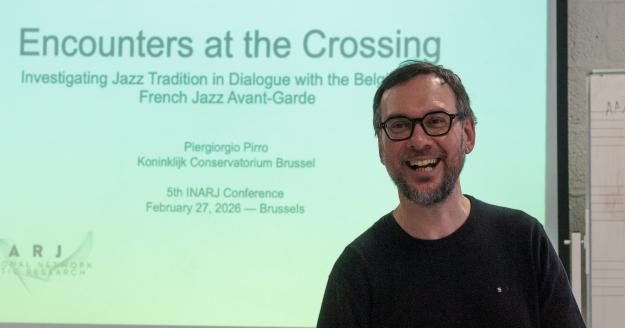
Conference of the International Network for Artistic Research in Jazz @ KCB 
© Rik Cornelissen

Pirro defended his PhD in January 2026, but has already launched a new research project at the Koninklijk Conservatorium Brussel, titled Encounters at the Crossing. This time, the focus shifts to the tension between jazz tradition and avant-garde practices.

“Many musicians struggle with that question: how do you relate to the past while creating something new?”
The project again centres on practice. Students collaborate with guest artists from the Belgian and French jazz scenes, developing material through workshops and performances.

Asked what advice he would give to young researchers, Piergiorgio Pirro emphasises action. “Get your hands dirty,” he says. “Artistic research has to be grounded in practice. Design projects that make you - and the people around you - actually do things, and have fun with it.” For him, research is not separate from artistic life. It is a way of engaging more deeply with music through experimentation, collaboration and shared exploration.

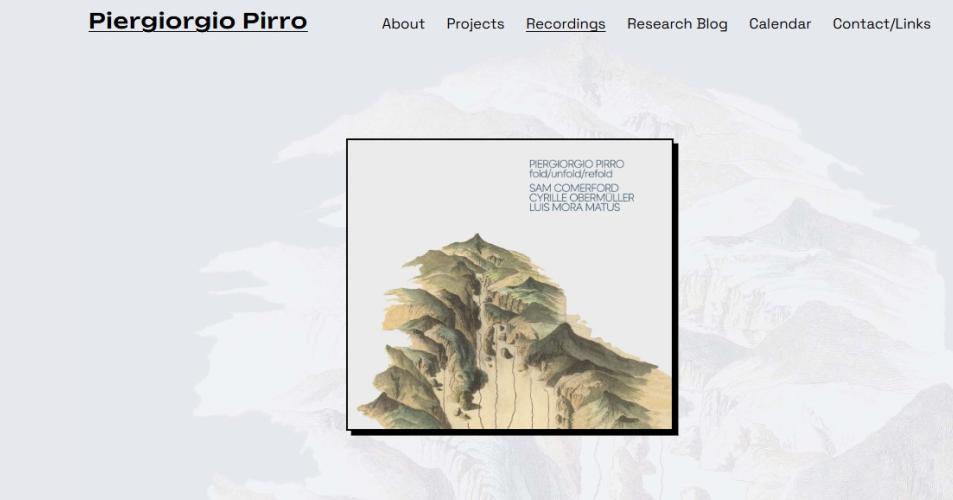
Discography

👉Would you like to find out more about Piergiorgio Pirro?: https://piergiorgiopirro.com/

👉Book your ticket here for his upcoming concert on xxx

Deel dit